CONTEXT
The work started here.
A first product combined AI-written small-business security assessments, interviews, and exportable reports.
BUILD
What was built.
My first product: a small business answers ~25 questions and gets an AI-written security assessment, an AI interview that digs deeper, and an exportable report, across three paid tiers. Started off GitHub in late January; 160 commits over 15 active days once the repository existed.
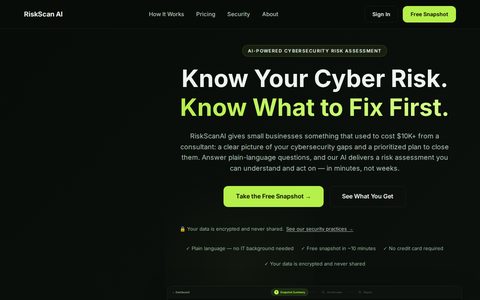
- The pitch: a consultant-grade risk assessment that used to cost $10K+, delivered from plain-language questions.
- Take the free snapshot — the funnel starts unauthenticated by design; guest, free, and paid tiers gate at the paid features.
- A linked security-practices page — the one hardening day that replaced decorative token checks with real verification sits behind it.
- Plain language, a ~10-minute snapshot, no credit card — the conversion framing of the three tiers.
PROJECT DESIGN
How it was shaped.
First product, first agent workflow, and where the foundational patterns got paid for: the async background-work architecture from a six-day timeout war, a one-day security retrofit that replaced decorative token checks with real verification, and a failure taxonomy for AI output that maps what users see to which contract piece broke.
Key modules
Snapshot engine
A 21-question, 5-section intake feeding deterministic domain scoring.
Derived-signals processor
Computes risk tier, compliance tracks, and active signals server-side — stable for prompt caching.
Summary pipeline
Returns a 202 and generates the Claude risk summary in a background function the frontend polls.
Interview chat
A domain-by-domain CIS IG1 gap interview that emits structured state via delimiter blocks.
Report generation
Enriches findings into a NIST CSF view with PDF and PowerPoint exports.
Access & payments
Three-tier guest/free/paid gating over Clerk + Stripe with idempotent webhooks.
Key features
Never await an LLM — the async summary
Netlify cuts off an HTTP request at 26 seconds; a Claude summary under load can take longer. The first version called the model inline, so heavy requests returned a 504 error page that the frontend then tried to parse as JSON — and crashed. The fix splits the work: finishing the questionnaire returns immediately with a deterministic summary built from the derived signals, schedules the Claude call in a background function with a 15-minute budget, and the page polls every few seconds, swapping in the richer AI version when it's ready. The user never stares at a spinner waiting on the model.
SECURITY & OPS
The operating decisions.
- The early prototype skipped token signature verification — before any real users or data were on the site. One hardening commit added full verification, security headers, webhook idempotency, and timing-safe admin comparisons across 13 files.
- Row-level security on all five tables keys on the JWT subject claim, with service-role functions re-enforcing ownership in code as a deliberate second layer.
- The funnel starts unauthenticated by design: guest, free, and paid tiers were a conversion decision, with the gates at the paid features.
BUILDER NOTES
What the build taught.
- Never await an LLM inside a serverless request: return 202 in under a second, run the model in a background function, poll for the result — the fix after a six-day timeout battle.
- A model ID and its feature set are one unit: pin them together and document the pairing, or every upgrade silently breaks the prompt machinery built around the old model.
- An autonomous overnight agent run produced ~20 commits from a written playbook with stop conditions — fixed test infrastructure, an error boundary, SEO, and five page redesigns.
- Dead code was deleted with a documented restore path: ~8,700 lines removed, every deletion logged with its one-line git restore command.
LESSONS
What changed afterward.
- Never make a user wait on an AI inside a web request: acknowledge instantly, work in the background, show progress. Perceived wait dropped from ~60 seconds to ~15.
- The prototype's security was decorative until one hardening day made it real: verify tokens properly, allowlist origins, leak nothing in error messages.
- An AI model and the prompt machinery around it are one unit. Swap one without the other and things break quietly.
- Validate AI output before trusting it: reject incomplete responses and fall back to something deterministic the user can still use.
WHAT BROKE
A web request could not carry the AI wait.
A six-day timeout war established the background-work pattern: acknowledge promptly, run slow work outside the request, and show progress.
CONTROL
The constraint that held.
AI output is rejected when incomplete and replaced with deterministic fallback; token and origin handling were hardened after the prototype phase.
EVIDENCE
Where to inspect it next.
- The early prototype skipped token signature verification — before any real users or data were on the site. One hardening commit added full verification, security headers, webhook idempotency, and timing-safe admin comparisons across 13 files.
- Row-level security on all five tables keys on the JWT subject claim, with service-role functions re-enforcing ownership in code as a deliberate second layer.
- The funnel starts unauthenticated by design: guest, free, and paid tiers were a conversion decision, with the gates at the paid features.
CARRIED FORWARD
What survived the project.
Everything: the successor is literally the same repository continued. Six agent skills and three reviewer agents survived into a roster that grew to 42 and 11, and the honest verdict (“nobody pays for an AI-interview risk assessment”) re-aimed the product at a question businesses do pay for.
WRITING